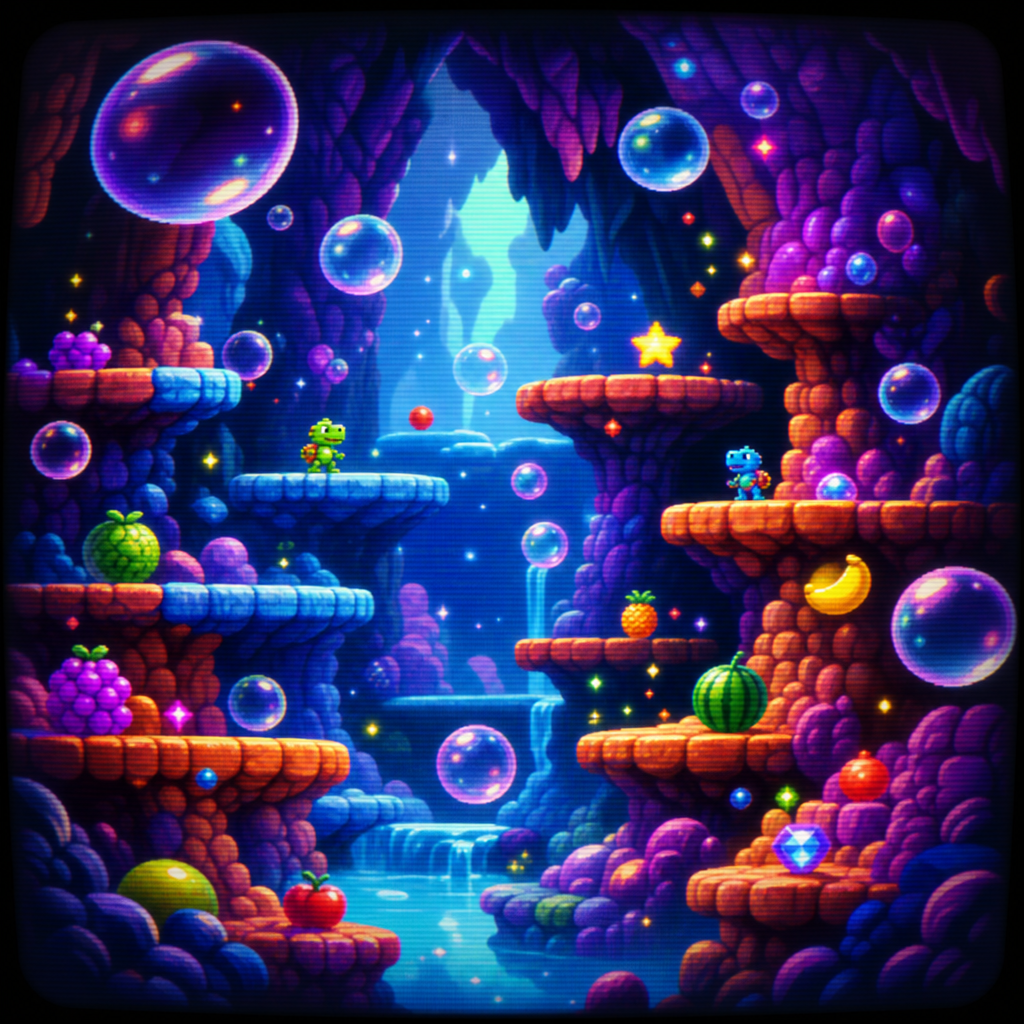
Title Bubble Bobble
Developer Taito
Publisher Taito
Year 1986
Platform focus Arcade original release
Genre Single-screen platformer
Score 9 / 10
Bubble Bobble is one of those retro games that can look almost too cheerful to be dangerous. Bright colours, bouncy music, little monsters, fruit everywhere — it practically dares you to underestimate it. The real search question in 2026 is not whether Taito’s 1986 arcade hit is important. It is whether it still feels worth your time when you have no childhood attachment to it and a thousand other “all-time classics” fighting for your attention.
The answer is an easy yes. Bubble Bobble still rules because it understands the difference between simple and shallow. The basic loop — blow bubbles, trap enemies, pop them, move on — is readable in seconds, but the game keeps finding new ways to turn that tiny rule set into panic, greed and slapstick teamwork. If Knight Lore asks you to admire a breakthrough and the current retro revival reminds us why old games are back in fashion, Bubble Bobble is the cleaner answer to why so many people still love arcade-era design: it is immediate, funny and absurdly replayable.
Why the Bubble-Popping Loop Still Works
The genius of Bubble Bobble is that every level feels like a tiny room-sized argument between control and chaos. You can trap enemies in bubbles, ride bubbles to awkward places, herd monsters into better positions, or panic and make a complete mess of things. Because each stage is only a screen wide, the consequences of your decisions are always visible. That gives the game a lovely snap. You are never far from either a clever recovery or a stupid death.
It also helps that Taito loaded the game with personality. Enemies wobble about like cartoon pests rather than abstract hitboxes. Bonus items shower out in a way that makes greed feel irresistible. The stages have a toybox quality to them, with ladders, platforms, gaps and little traps arranged just neatly enough to invite experimentation. Even now, the whole thing feels alive in a way many early platformers do not.
And then there is co-op. Played with two people, Bubble Bobble becomes one of the great arcade friendship tests: half coordination, half accidental sabotage. One player sets up a neat trap, the other barges in for the points, and suddenly everybody is improvising. That energy is a huge part of why the game aged so well. It is not just a strong solo score chaser; it is one of the most welcoming multiplayer arcade games of its era.
What Makes It Special in 2026
What really stands out today is how modern the game’s readability feels. The goal is obvious, the feedback is instant, and each round gives you a quick little story: who messed up, who got greedy, who stole the melon, who barely escaped the angry invincible enemy that turns up when you dawdle. A lot of retro games earn respect more easily than affection. Bubble Bobble earns both.
It also sits in a sweet spot for current retro search intent. People looking for the best co-op arcade games, the best pick-up-and-play retro platformers, or just a classic that still works in short sessions will find exactly what they want here. That is part of why the series has survived across ports, compilations and modern reissues. The core idea still travels beautifully.
There is even a little extra mystique around the arcade original thanks to its secrets and alternate endings. Bubble Bobble does not just clear 100 stages and leave. It nudges you into sharing rumours, replaying levels and treating it like more than a one-credit toy. That playground energy still matters.
What Feels Old in 2026
The main drawback is that the difficulty curve can turn from playful to rude without much warning. Late-game enemy speed, projectile clutter and awkward stage layouts can make the final stretch feel more exhausting than elegant. Solo play is also noticeably less magical. Still good, absolutely — but a big part of the game’s charm comes from co-op chaos, and you feel that absence when playing alone.
You also need to be slightly careful about which version you play. Bubble Bobble has been ported everywhere, and not every home conversion captures the arcade game’s exact rhythm or feel. If you want the cleanest first impression, start with the arcade original or a faithful modern collection.
Verdict
Bubble Bobble remains one of the best arcade platformers ever made because its design is generous without being soft. It is easy to read, hard to master, brilliant with friends and still packed with enough charm to make failure funny instead of miserable.
9 / 10. If you want a retro game that still feels instantly alive in 2026, this is one of the safest recommendations on the board. Few 1980s arcade games balance accessibility, depth and pure mischief this well.
- Pro tip: Play two-player if you can. The game’s reputation makes much more sense once the screen fills with shared panic.
- Pro tip: Do not chase every bonus item blindly. Space control matters more than greed once the later rounds start getting nasty.
- Authority link: For release history and platform details, see Wikipedia’s Bubble Bobble overview.
- Authority link: For arcade-version oddities and hidden development leftovers, see The Cutting Room Floor’s Bubble Bobble (Arcade) page.
Where do you rank Bubble Bobble among arcade co-op greats — all-time classic, or a lovely sugar rush that fades before the end?