Title Crazy Taxi
Developer Hitmaker
Publisher Sega
Year 1999 (arcade), 2000 (Dreamcast)
Platform focus Dreamcast original release
Genre Arcade driving / score attack
Score 8 / 10
Crazy Taxi still asks a very healthy retro question in 2026: if you strip away nostalgia, licensed music memories, and Dreamcast affection, is Sega’s arcade taxi riot actually still fun to play today? I think the answer is yes. More than that, I think it is one of the easiest Dreamcast games to recommend to someone who wants instant action instead of homework. Few retro games explain themselves this quickly, and even fewer turn a simple idea into such a compulsive score chase.
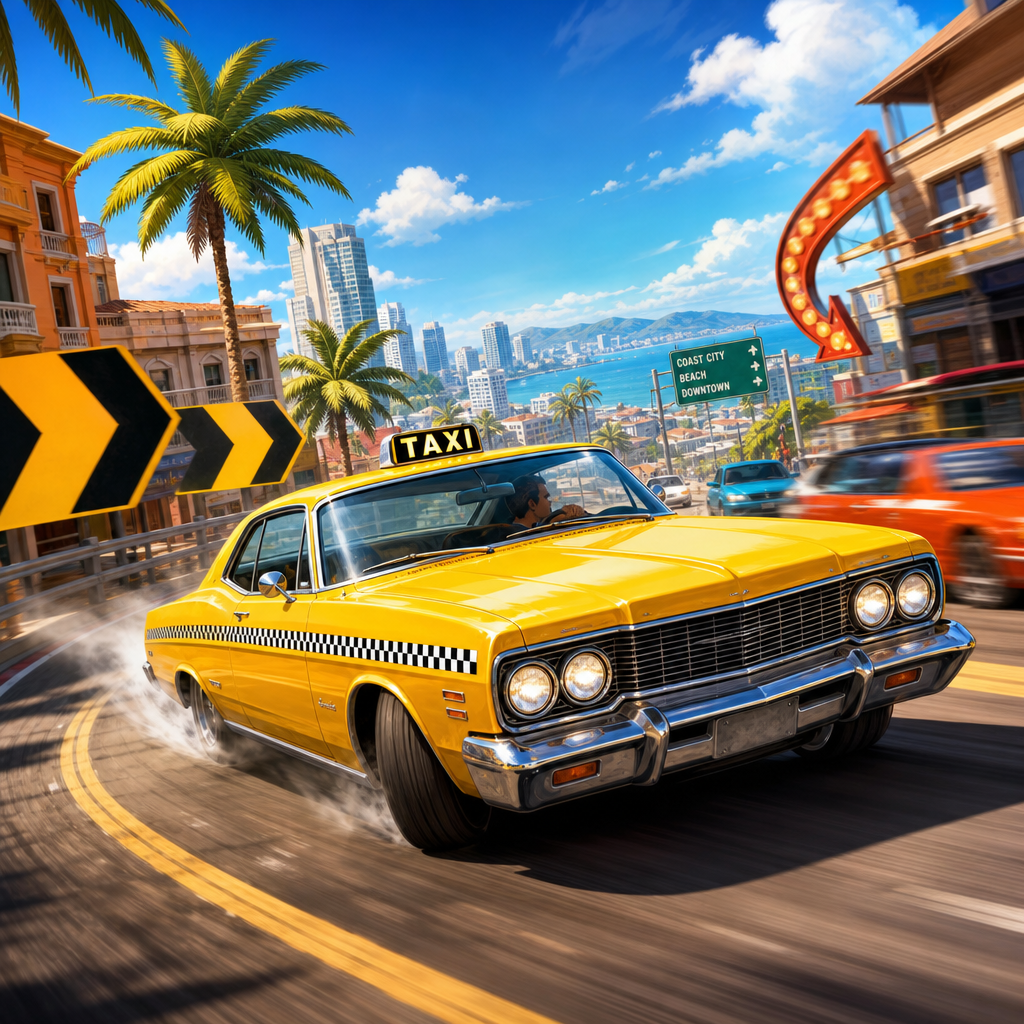
The pitch is wonderfully blunt. Pick up a fare, race to the destination, drive like a menace, and squeeze out extra cash with wild drifts, near-misses, and risky shortcuts before the clock runs dry. That loop sounds almost too thin on paper, but Crazy Taxi understands exactly what makes arcade design stick. It throws you into a city that feels open enough to invite improvisation, then rewards aggression, route knowledge, and nerve. Within minutes, you stop driving safely and start thinking like a greedy speed demon.
Why Crazy Taxi Still Feels So Good
The biggest strength is momentum. Crazy Taxi feels fast in the way older arcade games often did: not because of realism, but because every second is charged with consequence. The timer is always threatening you, passengers are always judging you, and the city always seems one bad corner away from disaster. That pressure gives even ordinary fares a lovely sense of chaos.
I also think the game’s readability deserves more credit. The giant directional arrow is such a smart piece of design. It keeps the pace high without turning the city into a confusing maze, which means the real skill comes from learning better routes rather than fighting the interface. Like Out Run, this is an arcade Sega game that understands movement should feel playful before it feels technical.
The tone helps too. This is not a serious driving sim pretending to be a city sandbox. It is loud, silly, and proudly gamey. Customers leap into the cab, destinations flash up, and every successful drop-off makes you want to chain one more run together. There is a purity to that which still lands beautifully in 2026, especially if you miss the more rebellious side of old Sega design we talked about in our feature on Sega’s surviving classic reboots.
Where the Age Shows
The downside is that Crazy Taxi is not especially deep once the initial rush settles. The map is memorable, but the activity range is narrow by design. If you need story, progression systems, or a sense that the world changes around you, this will feel slight very quickly. It is an arcade machine at heart, and it never pretends otherwise.
The collision-heavy chaos can also be messy in ways that are funny right up until they are not. Part of the charm is clipping traffic, bouncing off street furniture, and somehow salvaging the fare anyway. Part of the frustration is realising a strong run can evaporate because you misread a turn or got tangled in the city’s louder physics. Compared with the smoother style-first flow of Jet Set Radio, Crazy Taxi is more immediately accessible, but it can still feel rough around the edges.
Why It Is Still Worth Playing in 2026
What keeps it alive is how little fat there is on the whole thing. You can sit down for ten minutes and get exactly what you came for: speed, risk, noise, and the satisfaction of shaving seconds off a route you already thought you understood. That makes it one of the better answers to an evergreen collector-and-curiosity search: which Dreamcast games are still genuinely fun, not just historically important?
I would not call it the richest game in Sega’s back catalogue, but I would absolutely call it one of the cleanest expressions of arcade fun the company ever shipped. If you enjoy score attack design, chasing mastery, or simply yelling at traffic while punk music blares in the background, Crazy Taxi still earns its place.
Verdict
Crazy Taxi remains a terrific burst of arcade energy: simple, reckless, readable, and immediately entertaining. It lacks the depth to dominate long sessions in the way some all-time greats do, but as a pick-up-and-play Dreamcast classic it still feels sharp, funny, and very easy to recommend.
8 / 10. If you want a retro game that gets to the fun in seconds and keeps daring you to drive worse for better results, Crazy Taxi still delivers.
- Play tip: Learn a few dependable shortcuts before chasing maximum-risk routes; steady knowledge beats panic speed.
- Play tip: Use the directional arrow as a guide, not a command. The fastest route is often not the most obvious road.
- Authority link: Wikipedia overview of Crazy Taxi
- Authority link: MobyGames entry for Crazy Taxi
Would you still put Crazy Taxi near the top of the Dreamcast pile, or has one-note arcade brilliance become a tougher sell for you in 2026?