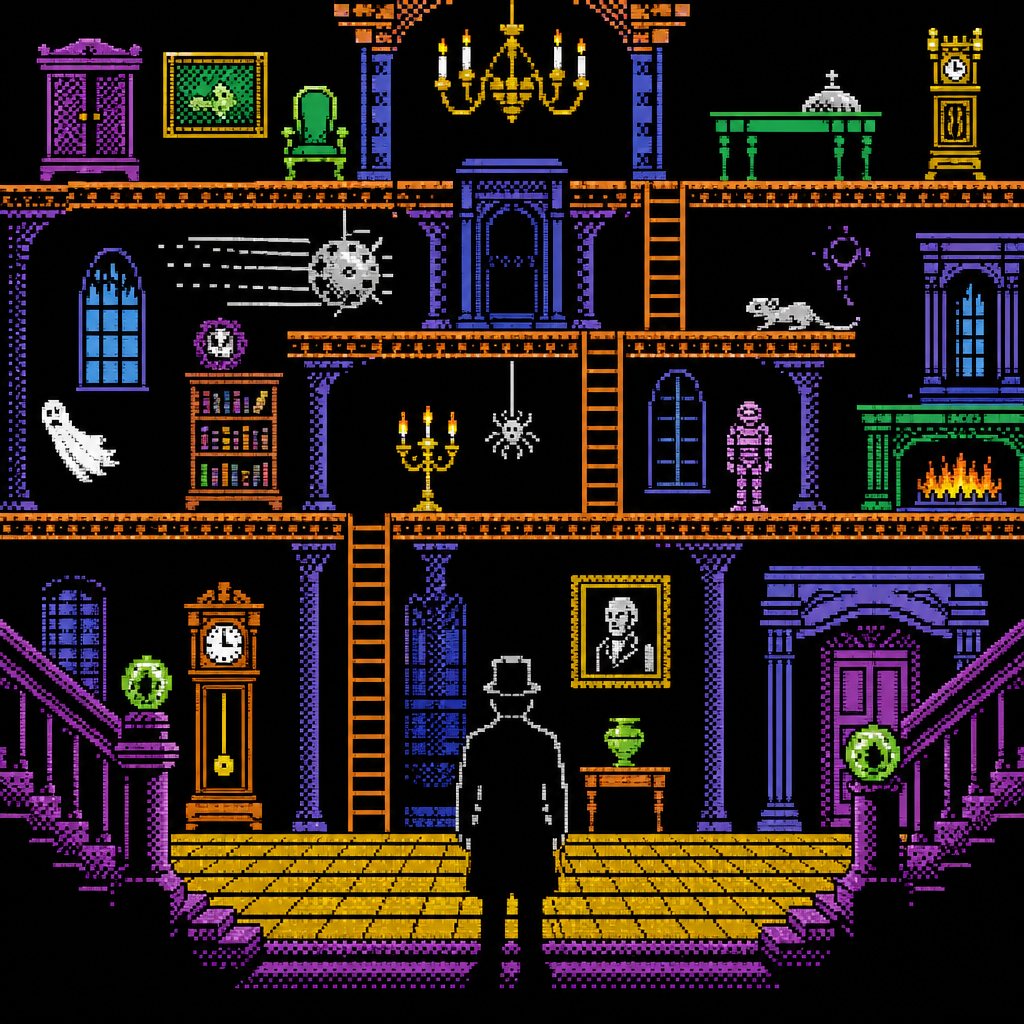
Title Jet Set Willy
Developer Matthew Smith
Publisher Software Projects
Year 1984
Platform reviewed ZX Spectrum
Genre Platform game
Score 7 / 10
There is a very particular kind of British 8-bit cruelty that nobody has ever quite replicated. Jet Set Willy is one of the purest examples: a game about tidying your mansion after a party that somehow feels like being personally bullied by architecture. Released in 1984 for the ZX Spectrum, Matthew Smith’s sequel to Manic Miner took a compact arcade challenge and exploded it into a weird, sprawling house full of lethal rope physics, sadistic jumps and some of the most memorable room names in gaming.
The search question in 2026 is simple: is Jet Set Willy still worth playing, or is it one of those sacred retro cows that only survives on reputation? The answer is pleasingly awkward. It is absolutely worth playing, but you need to meet it on its own terms — as a landmark piece of British microcomputer design, not a polished modern platformer.
The Brief
Willy has thrown a catastrophic party, the house is a tip, and his housekeeper Maria will not let him sleep until every item has been collected. That is the entire plot, and it is perfect. The setup gives Smith an excuse to build a mansion that feels less like a level list and more like a hostile dream map. Rooms connect in surprising ways. Routes loop back on themselves. Progress is not linear so much as exploratory, which was a big deal in 1984. Where Manic Miner shoved you through one test chamber after another, Jet Set Willy lets you wander off and discover your next disaster for yourself.
What Makes It Special
The first thing that still works brilliantly is the sense of place. Jet Set Willy is a platform game, but it also feels like a house you come to know. You remember problem rooms. You develop grudges. You learn where the rope timing is generous, where it is vile, and which staircases are lying to you. That strange intimacy is part of why the game lingers in memory so much more vividly than many better-behaved contemporaries.
The second strength is its commitment to movement rules that are simple but never trivial. Willy can run, jump, climb and grab ropes. That is it. Yet entire rooms are built around tiny variations in timing and rhythm. In that sense, it sits in the same British lineage as Chuckie Egg: games that look straightforward until you realise every screen is a compact argument about momentum, space and nerves.
And then there is the atmosphere. The Spectrum original has that unmistakable colour-clash charm, but there is more personality here than the technical limitations suggest. The mansion is funny, eerie and slightly surreal. Even the bugs and oddities contribute to the legend. This is one of those games that helps explain why the current retro revival keeps pulling players back to the British 8-bit era: not because these games are smooth, but because they feel authored in such a specific human way.
Why It Still Frustrates
For all its historical importance, Jet Set Willy can also be a nuisance. Collision can feel unforgiving. Some jumps demand faith before they earn trust. The rope rooms are famous for a reason, and not always a flattering one. Depending on which version you play, you may also run into the game’s long-documented bugs and quirks. None of this makes it unplayable, but it does mean the game is easier to admire than to love unconditionally.
That is really the dividing line. If you want a clean, frictionless platformer, there are dozens of better choices. If you want to understand why British bedroom coders were treated like rock stars, Jet Set Willy still delivers. It is imaginative, ambitious and gloriously stubborn.
Verdict
Jet Set Willy earns its reputation, even if it does not always earn your patience. As a sequel, it is messier and more ambitious than Manic Miner, trading perfect arcade compression for a much bigger world and a much stranger personality. Not every room is fair. Not every idea lands. But when the game clicks, it feels like discovering a secret architectural language from the early days of home computing.
7 / 10. Not the friendliest Spectrum classic, but still one of the most important — and one of the easiest to recommend to anyone curious about how weird, witty and uncompromising 1984 platform design could be.
- Pro tip: Treat each room like a puzzle, not a sprint. Greed causes most deaths.
- Pro tip: On rope screens, watch the swing for a full cycle before committing.
- Authority link: For release history and version details, start with Wikipedia’s Jet Set Willy overview.
Did Jet Set Willy charm you into one more run, or did it send you straight back to kinder platformers? I’d love to know which room broke your patience first.